
Last updated September 22, 2026
Free on-site gate assessment - hinges, posts, and your LiftMaster or Nice gate operator checked before anything is quoted
The assessment is free and the quote is the invoice.


 Before
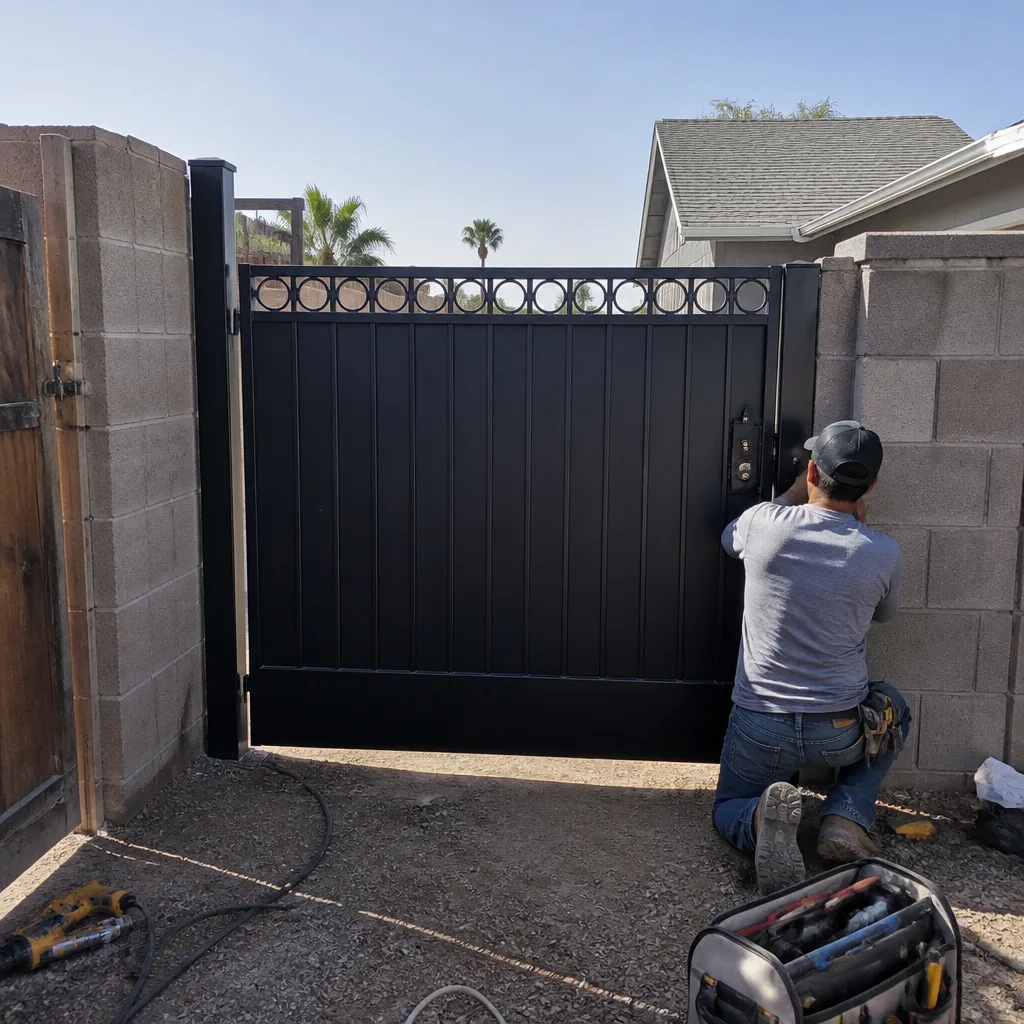 After
After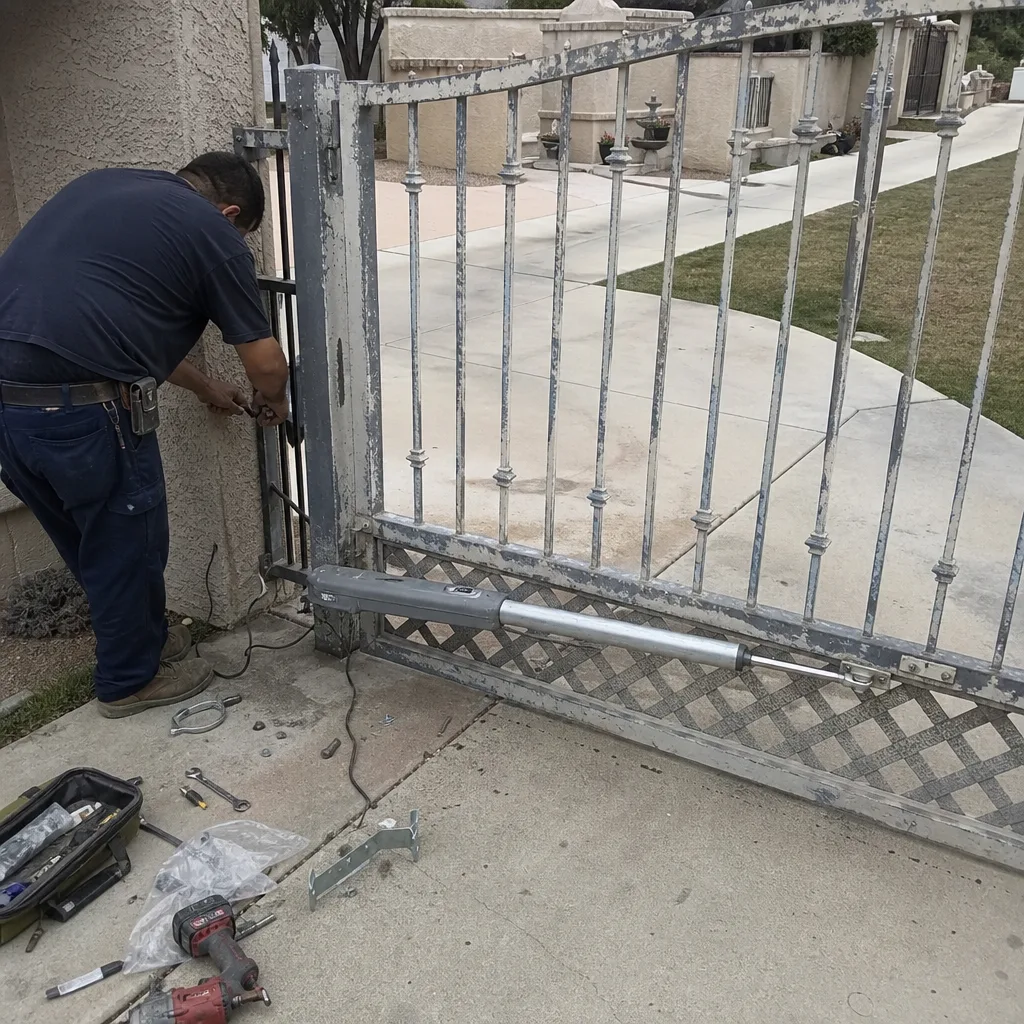 Before
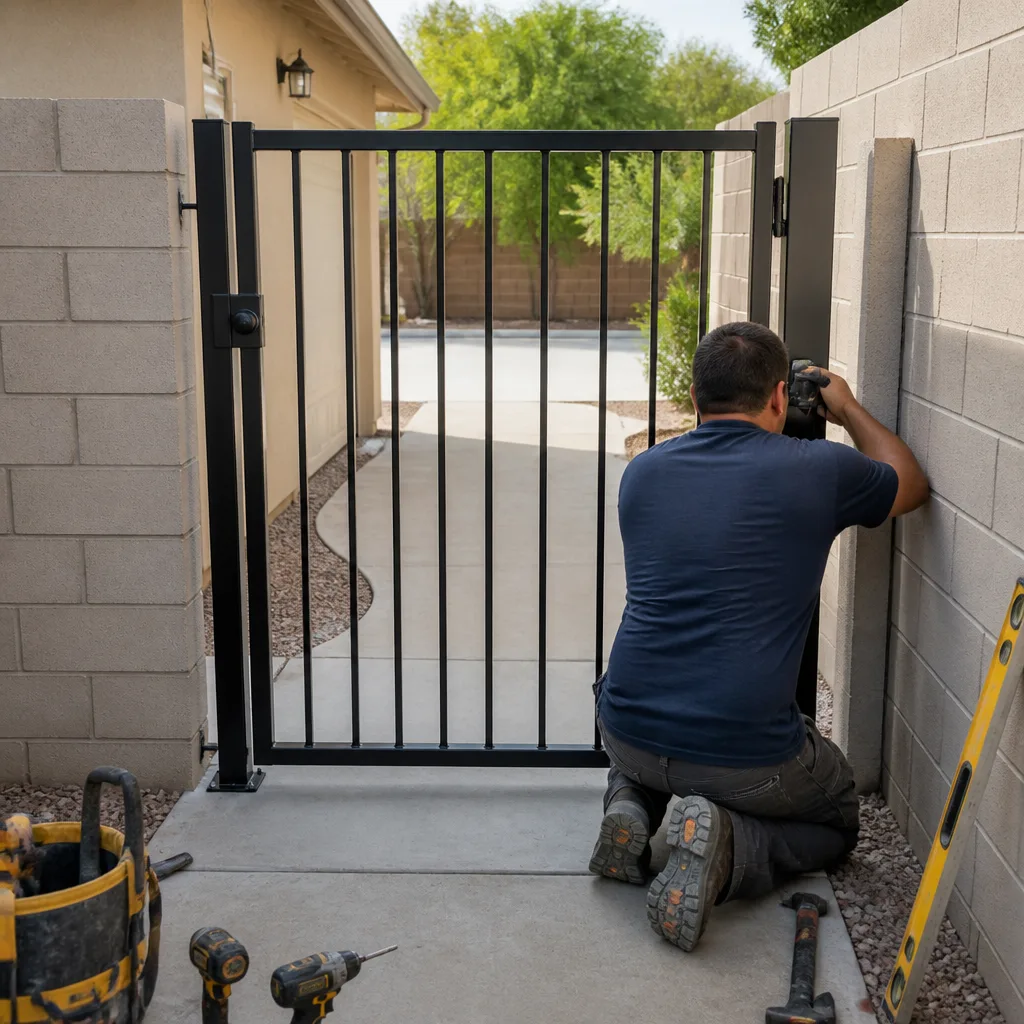 After
After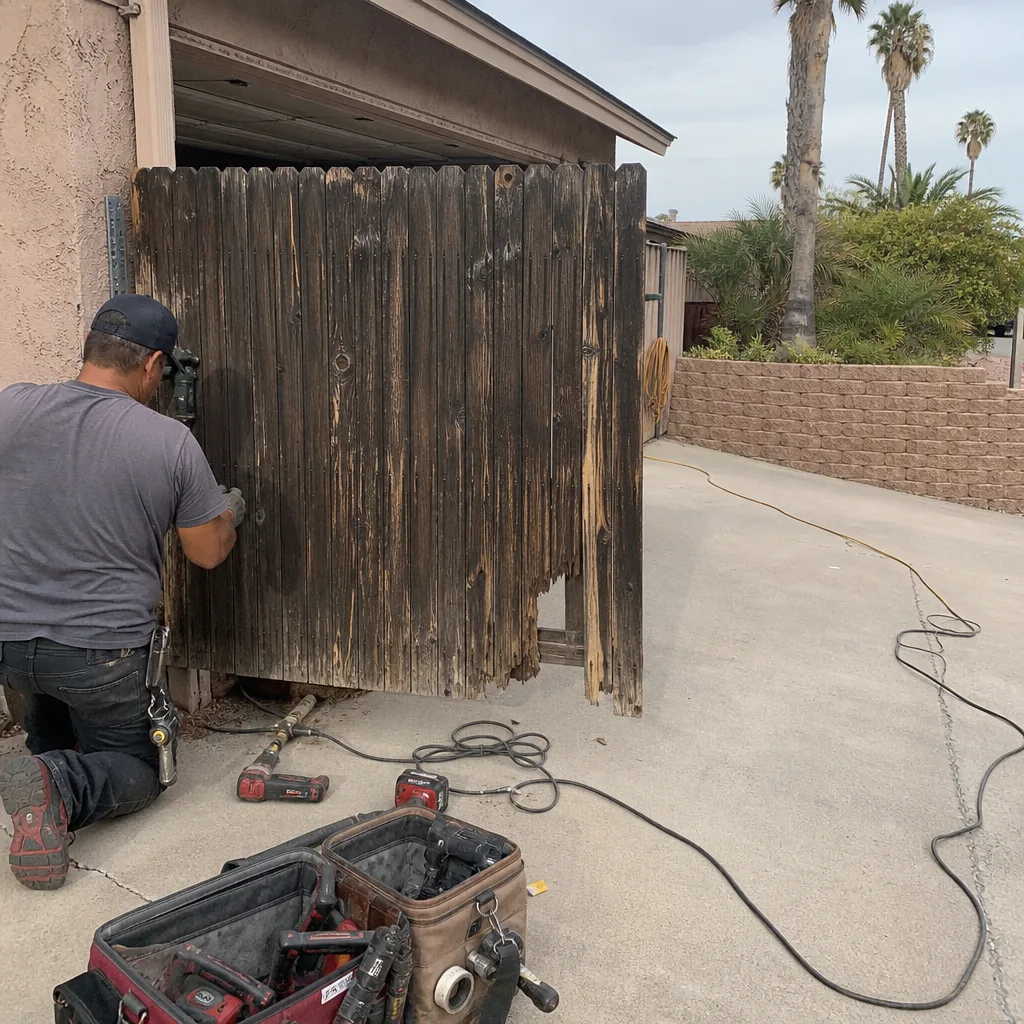 Before
 After
AfterHow to Hire a Gate Repair Contractor in Tempe: A Step-by-Step Guide
The most common gate repair complaint in Tempe isn’t bad work - it’s a verbal estimate that became an invoice nobody agreed to. We’ve taken calls from homeowners in Kiwanis Park and Maple-Ash who were quoted $400 over the phone and handed a $900 bill three hours later. The fix isn’t finding a better contractor; it’s asking for a document most contractors don’t offer unless you demand it. This guide - alongside our Complete Guide to Gate Repair in Tempe - shows you the exact paperwork to request, the exact answers that should end a phone call, and the four documents every legitimate gate contractor in Tempe should produce before you pay a dollar.
Quick Answer
To hire a gate repair contractor in Tempe, verify their Arizona ROC license online, demand a written line-item estimate before any work starts, confirm they carry liability insurance naming you as additional insured, and require a post-job photo report with wiring diagrams if electrical work was performed. Never accept “we’ll know the price when we open it up” - that’s a disqualifying answer in this market.
Table of Contents
- Why Documentation Matters More Than Credentials
- The Four Documents Every Gate Contractor Must Produce
- Phone Screening: Exact Questions and Disqualifying Answers
- How to Verify an Arizona ROC License in Under Two Minutes
- Gate Repair Company vs. General Handyman
- Your Post-Job Handoff Checklist
- Tempe-Specific Considerations: Climate, Codes, and Neighborhoods
- Common Mistakes to Avoid
- When to Call a Professional
- Frequently Asked Questions
- The Bottom Line
 Before
 After
AfterWhy Documentation Matters More Than Credentials
Every gate contractor in Tempe will tell you they’re licensed and insured. Most are. The problem is that a license proves someone passed a test and paid a fee - it doesn’t prove they’ll honor a price, warranty a part, or remember what they adjusted six months later when the same failure returns.
We’ve been repairing and installing gates in Tempe since 2014, and our file cabinets (now digital) contain the documentation from over 22,000 jobs. The pattern is consistent: the disputes that cost homeowners the most money almost always trace back to something that was said but not written. A verbal promise of “lifetime warranty on the motor.” A handshake agreement that “we’ll come back if it doesn’t work right.” An assurance that “the price won’t change.”
Documentation solves this by making every promise verifiable and every finding reproducible. When a technician in our crew replaces a Linear actuator on a sliding gate in North Tempe, we photograph the old unit’s serial number, the mounting bracket condition, the new unit’s limit-switch settings, and the final travel path. If that gate drifts six months later, we don’t guess what happened. We pull the file, see that the bracket was cracked when we arrived (photo 3 of 12), and know whether the drift is a new problem or an unresolved one.
This is the core of The Haven Standard, the documentation protocol Adrian Vance developed on commercial access-control sites and applied to every residential job:
- Clause 1 - Have it in writing: A written scope and written price before any tool touches the gate.
- Clause 4 - Evidence on every job: Photographic documentation of what was found, what was adjusted, and what was installed, provided to the homeowner and filed in the job record.
- Clause 7 - Make it right: The 365-Day Done Right Promise, covering all completed work with no expiration within that window and no additional charge for corrections.
These clauses protect both parties. The homeowner knows exactly what they’re paying for. The contractor has a record that prevents false claims. And any future technician - whether from our company or another - can see what was done without charging the homeowner to rediscover it.
The rest of this guide teaches you to demand this standard from any contractor you hire in Tempe, whether it’s our Gate Repair services or someone else.
The Four Documents Every Gate Contractor Must Produce
Before you sign anything or pay anything, a legitimate gate repair contractor in Tempe should hand you four documents. If they can’t or won’t, the conversation is over.
Document 1: Written Estimate with Line-Item Scope
This is not a text message saying “probably around $500.” It’s a printed or emailed document that lists:
- Each task to be performed (diagnostic, part replacement, adjustment, welding, etc.)
- Each part to be installed, with manufacturer and model number
- Labor hours or flat labor rate applied
- Subtotal, tax, and total
- A statement that the total will not exceed the written amount without your signed approval
Under The Haven Standard - detailed further in our Seasonal Gate Repair Care for Tempe: Year-Round Homeowner’s Guide - we deliver this document and require your signature before any work begins. If a contractor says “I’ll write it up after I see what’s wrong,” that’s acceptable for the diagnostic phase - but the full estimate must still be written and approved before repair work starts. “We’ll know the price when we open it up” is a disqualifying answer. It means either the contractor doesn’t know their own pricing, or they’re reserving the right to charge whatever they want once you’re committed.
Document 2: ROC License Verification
The Arizona Registrar of Contractors (ROC) issues license numbers to qualified contractors. Every gate repair contractor working in Tempe must display their ROC number in advertising and on contracts. We’ll cover exactly how to verify this in the next section.
Document 3: Certificate of Liability Insurance
This certificate, provided by the contractor’s insurance broker, should name you or your property address as additional insured for the duration of the job. It proves that if a technician damages your vehicle, your home, or themselves on your property, their policy covers it - not your homeowner’s insurance.
General handymen often carry no liability insurance, or a policy too small to cover gate-related damage. A single gate motor falling from a lifted position can do $10,000 in damage to a parked car. Verify the certificate exists and is current.
Document 4: Post-Job Report with Photos
After the work is complete, you should receive:
- A written summary of what was found during diagnosis
- What was adjusted, replaced, or welded
- Part numbers and serial numbers of installed components
- Photographs of the work area, installed parts, and any relevant settings (limit switches, photo-eye alignment, etc.)
- Wiring diagrams if any electrical work was performed
- The technician’s name and the date of service
This document is your warranty protection and your future diagnostic shortcut. When we service a Ghost Controls system in Warner Ranch and the homeowner calls two years later with a new issue, we pull the photo log and know exactly what we left behind. No re-diagnostic fee. No guesswork.
Phone Screening: Exact Questions and Disqualifying Answers
The phone call is where most homeowners in Tempe get captured by bad contractors. Here’s the exact screening protocol we recommend, developed from 22,000+ customer interactions, with more guides & resources available on our blog.
Question 1: “Can you send me a written estimate before any work starts?”
Good answer: “Yes. We’ll diagnose the issue, write up the full scope and price, and you’ll approve it in writing before we begin repairs.”
Disqualifying answer: “We can’t know the price until we open it up” or “The technician will tell you when he gets there.”
The only acceptable variation is a flat diagnostic fee with a written estimate to follow. We charge a diagnostic fee in Tempe that is credited toward the repair if you proceed. The key is that you see and approve the full price before repair work begins.
Question 2: “What’s your ROC license number, and under what name is it registered?”
Good answer: An immediate, unhesitating number and company name that matches the name on their website and trucks.
Disqualifying answer: “We’re licensed, don’t worry about it” or “I’ll have the office send that later” or a number that doesn’t match the company name (possible license borrowing).
Question 3: “Will you provide a certificate of liability insurance naming me as additional insured?”
Good answer: “Yes, we can email that before the technician arrives.”
Disqualifying answer: “We have insurance, but we don’t do certificates for small jobs” or any hesitation that suggests the policy doesn’t exist or has lapsed.
Question 4: “What documentation do I receive after the job is done?”
Good answer: “You’ll get a written report with photos of the work, part numbers installed, and any settings we adjusted. If we did electrical work, you’ll get a wiring diagram.”
Disqualifying answer: “We give you a receipt” or “The technician will explain what he did.”
Question 5: “What happens if the same problem comes back in three months?”
Good answer: A specific warranty period with specific coverage terms. “Our 365-Day Done Right Promise covers all completed work. If the same issue returns, we fix it at no charge.”
Disqualifying answer: “We’ll take care of you” or “Call us if there’s a problem” with no written warranty document.
Question 6: “Do you stock parts for my brand, or will you need to order?”
Good answer: Specific brand knowledge. “We carry common Linear and Viking parts on our trucks. For a BFT system, we’d need to check stock - most BFT components are available within 24 hours in the Phoenix metro.”
Disqualifying answer: “We can get any part” (meaning they have no stock and no supplier relationships) or “We usually just replace the whole motor” (meaning they don’t diagnose - they sell).
We service nine major automation brands - gate motor & opener in Tempe including LiftMaster, FAAC, BFT, Linear, Viking, Ghost Controls, DoorKing, Elite, and Mighty Mule - and our technicians carry the most common failure parts for each. In Tempe’s heat, capacitors and control boards fail predictably. We plan for that.
How to Verify an Arizona ROC License in Under Two Minutes
Arizona makes this easy. Here’s the exact process:
- Go to roc.az.gov and click “Verify a License.”
- Enter the license number the contractor provided. Do not search by company name - names change, numbers don’t.
- Review the results page for four specific items:
- Status: Must show “Active.” “Inactive,” “Suspended,” or “Revoked” means stop immediately.
- License type: For gate repair, look for R-62 (Minor Home Improvements), CR-21 (Hardscaping and Irrigation Systems), or CR-60 (Swimming Pools and Spas) depending on the scope. Large gate installations may require a CR-7 (Carpentry) or CR-11 (Electrical) for power-run work.
- Bond: Must show a current bond amount. In Arizona, this is typically $4,500-$15,000 depending on license classification.
- Complaint history: Click through to see if complaints were filed and how they were resolved. A pattern of complaints is more meaningful than a single old dispute.
- Cross-reference the business name on the ROC record with the name on the contractor’s website, truck, and estimate. Mismatches suggest license borrowing or a dissolved entity operating under a new name.
What the ROC lookup tells you vs. what it doesn’t:
The lookup confirms legal authorization to contract and basic financial responsibility (bond). It does not confirm quality of work, timeliness, or honesty. That’s why the four-document requirement and the phone screening questions matter - they filter for operational competence, not just legal compliance.
In Tempe, we’ve encountered two common ROC-related problems homeowners should watch for. First, a contractor with an active personal license who operates under a different business name with no formal entity - this creates warranty enforcement problems if the individual disappears. Second, a contractor whose license is active but whose bond lapsed yesterday; the ROC doesn’t always update bond status in real time, so ask to see the current bond certificate directly.
Gate Repair Company vs. General Handyman
This distinction costs Tempe homeowners thousands of dollars annually, and it’s not about skill - it’s about parts access, warranty infrastructure, and diagnostic depth.
A general handyman can absolutely adjust a gate hinge or tighten a chain. The problem arises when the issue is electrical, mechanical, or brand-specific. Here’s the practical difference:
| Factor | Gate Repair Specialist | General Handyman |
|---|---|---|
| Parts inventory | Carries capacitors, control boards, limit switches, and gear assemblies for 9+ brands on the truck | Orders generic parts after diagnosis; 3-7 day delay common |
| Brand-specific knowledge | Knows Viking’s error code sequences and Ghost Controls’ solar-panel voltage requirements from direct experience | Relies on generic troubleshooting; may misdiagnose brand-specific failures |
| Warranty processing | Can file warranty claims directly with manufacturers; has dealer accounts for parts replacement | No dealer relationship; homeowner must handle manufacturer warranty independently |
| Documentation | Provides wiring diagrams, photo logs, and serial number records as standard practice | Rarely documents electrical work; future repairs require rediscovery |
| Liability coverage | Carries policy sized for gate-specific risks (motor weight, electrical, automated movement) | May carry general liability too small for gate-related damage |
The financial risk is real. We’ve been called to Tempe homes where a handyman’s $200 “gate fix” resulted in a $1,800 motor replacement because the original diagnostic missed a failing capacitor that damaged the control board. The handyman was long gone, with no documentation to support a warranty claim and no parts relationship to source a replacement at cost.
For simple mechanical issues - lubrication, hinge adjustment, debris clearing - a handyman may be appropriate. For anything involving the motor, opener, access control, or electrical supply, the specialized diagnostic tools and parts inventory of a gate repair in Tempe specialist pays for itself on the first correct diagnosis.
Your Post-Job Handoff Checklist
Do not pay the final invoice until you have verified every item on this list. This is your only leverage to ensure complete documentation.
- Written invoice matching the approved estimate
Line items should match the pre-approved estimate exactly. Any deviation requires a change order with your signature. Check that part numbers on the invoice match the parts you can see installed.
- Photo log of the work performed
Minimum: wide shot of the gate area, close-up of installed parts, any adjusted settings (limit switches, photo-eye positions, control board dip switches). Under The Haven Standard, we provide 8-12 photos on a typical repair.
- Wiring diagram (if electrical work was performed)
This is non-negotiable for any power-run, control board replacement, or safety device installation. The diagram should show wire colors, terminal numbers, and device positions. If the contractor says “the factory diagram is online,” that’s insufficient - you need the as-built configuration of your specific installation.
- Warranty document with specific terms
What is covered, for how long, and what triggers voiding. “One year on parts and labor” is acceptable if written. Verbal promises are not.
- Technician name and company contact for follow-up
You should know who was on your property and how to reach the company directly. We provide the technician’s name and photo before dispatch, and it appears on every job record.
- Operational demonstration
The technician should cycle the gate through full open, full close, and safety-reverse (place a solid object in the path to confirm photo-eye or edge sensor function). Do not accept “it was working when I left” without witnessing the cycle yourself.
Keep these documents for the life of the gate plus five years. Tempe’s extreme heat cycles and monsoon moisture degrade components faster than milder climates, and a failure in year three may trace back to an installation detail from year one.
Tempe-Specific Considerations: Climate, Codes, and Neighborhoods
Tempe’s environment creates gate failure patterns that contractors from cooler climates don’t anticipate. When you hire locally, you’re not just getting faster response - you’re getting technicians who’ve seen what July does to a Ghost Controls solar panel mounted on west-facing stucco.
Heat and UV Exposure
Tempe averages 108 days above 100°F annually. Gate motor housings in direct sun reach internal temperatures of 140-160°F, accelerating capacitor failure and degrading plastic gears. In our experience, Vance Gate Repair Tempe home capacitors fail 40% faster in Tempe than in comparable installations in Prescott or Flagstaff.
This matters when evaluating a contractor’s parts choices. A technician who specifies a standard-temperature motor for a west-facing gate in Escalante will be back in 18 months. We specify high-temperature-rated components for sun-exposed installations and document the ambient temperature reading at the time of service.
Monsoon Moisture and Dust
July through September brings dust storms followed by heavy rain. Fine dust penetrates motor housings and control enclosures; subsequent moisture creates conductive paths that short control boards. Proper sealing - gaskets, conduit seals, and NEMA-rated enclosures - is essential. Ask your contractor specifically: “How are you sealing this against dust and moisture?” Generic answers suggest generic practice.
Soil and Foundation Movement
Tempe’s expansive clay soils shift with moisture changes, particularly in older neighborhoods like Maple-Ash and University Heights. Gate posts that were plumb in March may lean by October. A contractor who adjusts the gate without checking post stability is treating a symptom. We document post condition and plumb with every alignment service, and we flag when foundation repair or post re-pouring is needed before the gate will hold adjustment.
HOA and Historic District Requirements
Several Tempe neighborhoods have design review requirements for visible gate modifications. In the historic district near Mill Avenue, a gate style or material change may require HOA or city preservation approval. A local contractor knows which neighborhoods have active review boards and can advise on permit timing. We maintain a reference file of HOA contact points for major Tempe subdivisions and flag potential review requirements during the estimate phase.
Electrical Code: Underground Power Runs
Arizona follows NEC 2020 with state amendments. Any new underground power run to a gate motor in Tempe requires conduit at proper depth (18 inches for PVC, 6 inches for rigid metal in certain conditions), GFCI protection, and proper bonding. Unpermitted electrical work creates liability and insurance problems. Verify that your contractor will pull an electrical permit when required, or that their scope explicitly excludes power-run work if you’re handling that separately.
Common Mistakes to Avoid
- Accepting a phone estimate as binding. In Tempe’s competitive market, low phone estimates are a common capture tactic. The real price emerges after the technician arrives. Insist on a written, on-site estimate before approving work.
- Hiring based on lowest price without comparing scope. A $350 estimate that replaces one hinge and a $600 estimate that replaces two hinges, adjusts the operator, and reseals the control enclosure are not comparable. Line-item detail reveals the difference.
- Neglecting to verify insurance. We’ve responded to Tempe homes where an uninsured worker fell from a ladder and the homeowner’s policy was primary. Request the certificate. It’s routine for legitimate contractors.
- Assuming all “licensed” contractors are equally qualified. An R-62 license allows minor home improvements; it does not demonstrate gate-specific competence. Ask about brand experience and request photos of similar completed work.
- Paying in full before documentation is delivered. The final payment is your only leverage for complete photo logs and wiring diagrams. Hold 10-15% until all documents are in hand.
- Ignoring the technician’s vehicle and appearance. Unmarked trucks, no company uniform, and reluctance to provide a name suggest day-labor dispatch, not employee accountability. We provide technician name and photo before every Tempe dispatch.
- Failing to ask about parts sourcing. Counterfeit control boards and rebuilt motors circulate in the Phoenix market. Ask where parts are sourced and whether they’re new OEM, factory-authorized, or aftermarket. We use new OEM or factory-authorized parts exclusively and document serial numbers for verification.
When to Call a Professional
Some gate issues are genuinely dangerous and should not be approached by homeowners. High-tension spring-assisted gates, hydraulic operators with pressurized lines, and any electrical work beyond resetting a breaker require trained technicians. If your gate is stuck partially open, creating a security exposure, or making grinding noises that suggest mechanical failure, professional diagnosis prevents further damage.
Vance Gate Repair Tempe offers free estimates in Tempe - call (623) 323-3849. A live person answers 24 hours a day, seven days a week. We’ll dispatch a background-checked, uniformed technician with a named photo provided before arrival, deliver a written price before any work starts, and leave you with a documented photo record of everything we found and everything we fixed.
Frequently Asked Questions
Most gate repairs in Tempe range from $180 for simple hinge and roller adjustments to $1,200+ for control board replacement with reprogramming on multi-brand systems. Swing-gate motor replacements typically run $850-$1,400 depending on brand and whether the arm bracket is intact; sliding-gate operator replacements range $1,100-$1,800 including limit-switch calibration and safety-device testing. We provide exact written pricing after diagnosis - call (623) 323-3849 for a free estimate.
For purely mechanical issues like hinge lubrication or debris clearing, a handyman may suffice. For motor, opener, access control, or electrical problems, a gate specialist provides brand-specific diagnostic tools, parts inventory, warranty processing, and liability coverage sized for automated gate risks. The cost of a misdiagnosed motor failure typically exceeds the savings from hiring a generalist.
Verify through roc.az.gov using the license number, not the company name. Confirm Active status, current bond, matching business name, and appropriate license classification for your scope of work. The lookup takes under two minutes and is the only reliable verification method.
You should receive a written invoice matching your approved estimate, a photo log of work performed, part numbers and serial numbers of installed components, a wiring diagram if electrical work was done, a warranty document with specific terms, and an operational demonstration of the repaired gate. Do not pay in full until all items are in hand.
Tempe’s extreme heat degrades capacitors, warps plastic gears, and reduces battery capacity in solar systems. Motors in direct sun experience internal temperatures 40-60°F above ambient. High-temperature-rated components and proper shading or ventilation extend service life significantly. We document ambient temperature at each summer service and recommend component upgrades when standard-rated parts are failing repeatedly.
We service nine major automation brands - LiftMaster, FAAC, BFT, Linear, Viking, Ghost Controls, DoorKing, Elite, and Mighty Mule - and carry common failure parts for each on our Tempe-area trucks. For gate installation in Tempe or repair, we do not steer customers toward replacement when repair is viable, and we do not promote exclusivity to any single brand.
The Bottom Line
Hiring a gate repair contractor in Tempe is a documentation problem, not a credentials problem. The ROC license confirms legal authority; the four documents - written estimate, verified license, insurance certificate, and post-job photo report - confirm operational competence and accountability. Ask the six phone screening questions. Verify the license yourself in two minutes. Hold final payment until your documentation is complete. The contractors who welcome this scrutiny are the ones who’ve built systems to support it. The ones who resist it are telling you exactly what kind of experience you’ll have.
At Vance Gate Repair Tempe, we built The Haven Standard because we were tired of seeing homeowners pay twice to rediscover the same problem. Written price before work starts. Photo evidence on every visit. One full year to make it right. That’s the standard we hold ourselves to, and it’s the standard you should demand from anyone you hire.
Written by Adrian Vance, Owner at Vance Gate Repair Tempe, serving Tempe since 2014.